Gasket Replacement Cost: What to Expect and How to Reduce It
Aiprel
professor
If you run gasketed plate heat exchangers, you already know gaskets do not fail at convenient times. The unit is running fine, then there is a weep at the frame, and suddenly you are pricing an emergency order, expedited freight and a maintenance window you did not plan for.
So the question every maintenance engineer eventually asks is simple: what will it actually cost to replace these gaskets? The honest answer is that there is no single number — but there is a calculable one, and once you know the six inputs, you can estimate a set before you request a single quotation.
This guide breaks down what drives the price, gives you the arithmetic to build your own estimate, and then covers the two levers that matter most: buying in batches, and making each set last longer.
What Actually Drives the Price
1. The gasket compound
The elastomer is the largest single variable. Standard NBR is the most economical and handles mineral oils, lubricants and suitable water duties. EPDM sits slightly above it and is the default for hot water and many steam duties. HNBR and FKM (Viton-type) cost noticeably more, because the raw materials are more expensive and curing control is tighter — but on hot oil or aggressive chemical duty they are not an upgrade, they are the only options that survive.
The trap is downgrading to save money. A standard NBR gasket on a 130 °C hot-water line can fail within months, and one unplanned shutdown usually costs more than the entire set. If you are unsure which compound your duty requires, the material-by-material comparison in NBR, EPDM, HNBR and FKM gasket materials is the fastest way to narrow it down.
2. Plate size
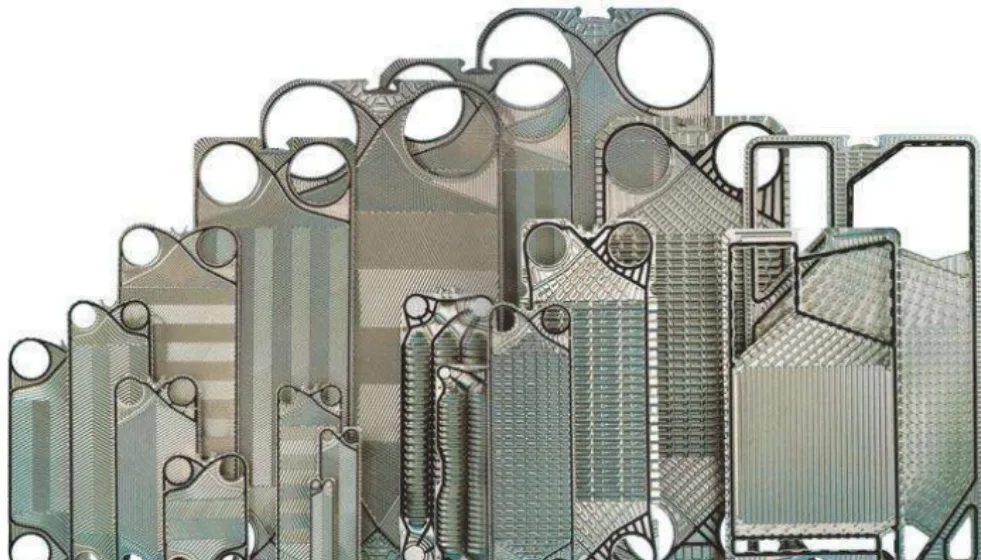
Gasket price scales with plate dimensions: more rubber, a longer sealing path, and a more complex mould. A gasket for a 0.2 m² plate and one for a 1.5 m² plate are not comparable line items. This is the most common reason two quotes for “the same gasket set” arrive 40% apart — one is priced on the right plate model, the other on a catalogue average. Always confirm the quote is against your exact plate model.
3. Mounting type: clip-on or glued
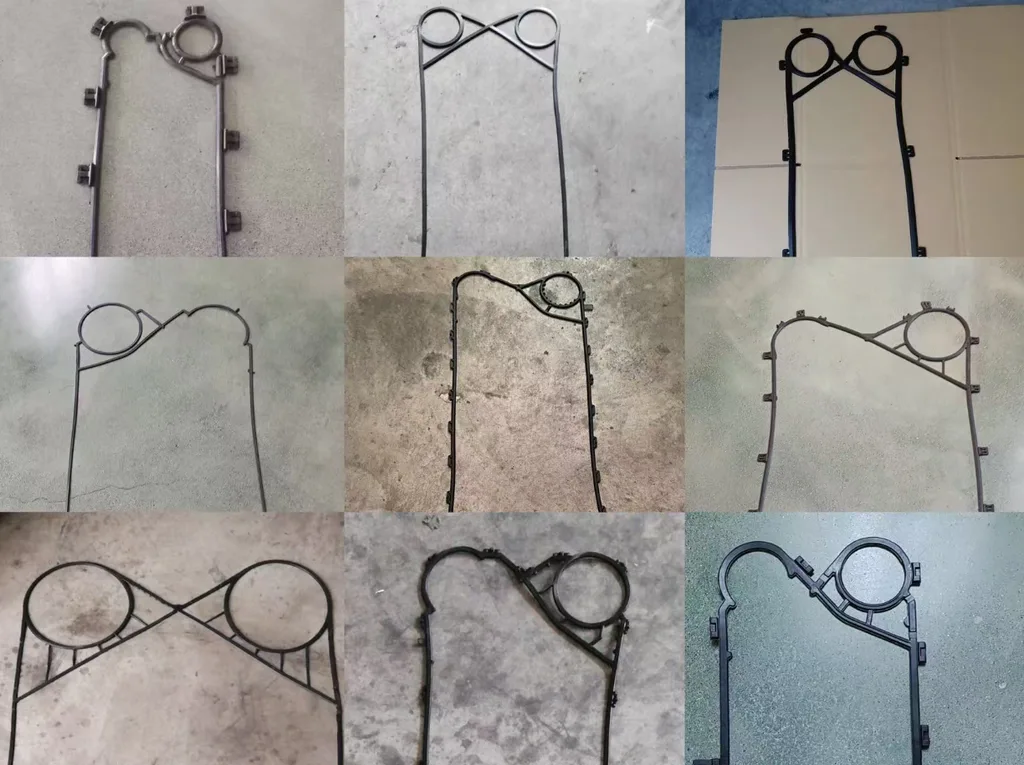
Clip-on gaskets cost slightly more per piece, because of the moulded fixing tails. They install without adhesive — faster to fit, easier to replace, and no glue residue in the plate groove. Glued gaskets are cheaper to make but add adhesive cost and hours of labour at every plate change. On a unit with 150 plates, that labour difference usually outweighs the unit-price gap the first time you re-gasket. We compare the two systems in detail in clip-on vs glued plate heat exchanger gaskets.
4. Order quantity
Gaskets are moulded parts, and every production run carries fixed setup cost — compound mixing, mould changeover, curing cycle, inspection. Order three pieces to patch a leak and that fixed cost is spread across three pieces. Order a full set, or two sets for units of the same model, and the per-piece price drops meaningfully. Ordering gaskets together with replacement plates also saves a freight leg.
5. Lead time
Urgency has a price, and it is usually the largest avoidable line on the invoice. When a unit is down and production is waiting, express freight and priority production are the only options, and both are charged at a premium. The same gasket ordered four weeks ahead fits into a normal production schedule at normal freight.
6. Downtime and labour — the line nobody quotes
Most buyers compare unit prices and stop there. But the rubber is often a minor share of what a re-gasket actually costs. Add technician hours, the shutdown itself, and the value of lost output, and the picture changes: a gasket that lasts 24 months instead of 12 halves your number of service events. That is why the cheapest gasket is frequently the most expensive one to own.
What the Numbers Look Like
Anyone who publishes a fixed price list for PHE gaskets is simplifying. The same plate model can vary meaningfully in price from one order to the next, because every one of the six factors above moves the number: compound grade, plate size, mounting style, quantity, tooling treatment and lead time. A price that looks high or low in isolation usually just sits at a different point on one of those six axes.
Relative order of magnitude, however, is stable across suppliers:
Compound — NBR sits at the low end. EPDM steps up moderately. HNBR and FKM sit at the top; expect FKM to be several times the NBR price for the same geometry.
Plate size — gasket price tracks plate area far more than plate count. The gasket for a > 1.0 m² plate is not “a bit more” than one for a 0.5 m² plate; it is a different order of quotation.
Mounting style — clip-on pieces carry extra moulding work, so per-piece they exceed glued equivalents; the gap narrows once installation labour is counted.
Quantity — a full set priced as one order lands well below the sum of single-piece prices, and repeat orders drop the tooling line entirely.
The honest way to get a number is a quotation built on your actual plate model and duty. That takes one exchange of a few details — model, plate count, medium, temperature — and returns a figure you can put in a budget line.
To turn any unit price into a real cost, use this:
Total cost of a re-gasket = (unit price × number of plates) + tooling or setup (first order only) + freight + (labour hours × site rate) + (downtime hours × cost of lost output)
Run that once for the cheap gasket and once for the correct one. The cheap option usually loses on the last two terms — and those are the two you cannot negotiate.
Why two quotes for the same set differ
When two suppliers quote the same plate model and the numbers are far apart, the gap is almost never profit margin. Look at these five things, in this order:
1.Compound actually quoted. “EPDM” covers a wide range; a standard compound and a high-temperature grade are different products at different prices.
2.Mounting style. A glued quote compared against a clip-on quote is not a like-for-like comparison, and the cheaper one will cost more to install.
3.Plate count. Confirm both quotes cover the same number of plates. Sets are frequently priced per plate but discussed per unit.
4.Tooling treatment. Some suppliers amortise mould cost into the unit price, others invoice it separately on the first order. The second looks cheaper per piece and is not.
5.Incoterm. Ex-works and CIF quotes differ by freight and insurance, which on a bulky low-value shipment is a large share of the total.
Ask for the quote broken down into these five lines. A supplier who can provide that breakdown is usually also the one whose gasket fits.
How to Reduce It
Buy in batches, before you need them
The cheapest gasket order is the one placed before the exchanger comes apart. Three habits do most of the work:
Keep one full spare set on site. For critical duties — pasteurization, cooling loops, marine coolers — a shelf spare turns a multi-day outage into a one-shift plate change.
Bundle with plates and with sister units. Same model, two or three sets, one shipment: better pricing, one freight leg, simpler inventory.
Forecast instead of reacting. Tally gasket consumption across all your units for a year and order against that number. It also protects you from raw-material price moves.
A workable rule: if a unit is two years into a gasket’s service life and you hold no spare set, the next purchase order should include one.
Make every set last longer
Each extra month of service life is direct savings, and the main killers of PHE gaskets are preventable:
Follow the plate pack dimension marked on the frame, tighten in a diagonal pattern, and never over-compress. Over-tightening is the most common cause of premature failure — and it is invisible until the gasket splits.
Treat the water side. High chloride content and biofouling attack plates and gaskets together. Basic water treatment pays for itself in gasket life.
Control CIP chemistry. Cleaning agents that are too hot or too concentrated chemically age the rubber; residual acid or caustic keeps working between cycles, so rinse properly.
Avoid thermal shock. Rapid swings harden and crack gaskets, especially EPDM in steam duty. Ramp gradually at start-up and shutdown.
Store spares correctly. Gaskets age on the shelf. Keep them boxed, out of sunlight, away from motors, welders and heat sources, and rotate first-in first-out.
A well-kept set in a clean hot-water circuit can serve several years. The same gasket in an abused oil circuit may not last one.
Match the gasket to your maintenance rhythm
If a unit is opened frequently, clip-on is usually worth the small premium: no glue, no curing wait, faster turnaround. If it is opened once every few years, glued gaskets are the budget-correct choice. This is a maintenance decision as much as a purchasing one, and it should be made once per unit, not once per order.
Three expensive myths
“Any gasket that fits the plate is equivalent.” Some aftermarket gaskets look identical and use recycled or under-cured compound. They leak early.
“Similar plate patterns are interchangeable.” A wrong gasket means a wasted set and a delayed repair. Check plate corrugation code, compound and mounting style before ordering.
“Cheap is cheap.” A 12-month gasket at 70% of the price of a 24-month gasket costs about 40% more per year of service.
Before You Commit: Free Samples
Replacing gaskets on a third-party exchanger — an Alfa Laval, GEA, Tranter, Sondex or other brand — always carries one doubt: will the fit be right? Nobody wants a full set that sits half a millimetre proud of the groove.
That is why we send free gasket samples: test the fit on your actual plate and check the compound against your duty, and you cover only the shipping. Order the set when you are confident, not before. Send your plate model and operating conditions through our inquiry page and we will come back with the compound, the mounting type and the quantity that fit — not just a unit price. Our full range of replacement heat exchanger gaskets covers NBR, EPDM, high-temperature EPDM, HNBR and FKM in glued, clip-on, snap-on and stud-mounted configurations.
FAQ
How much does one plate heat exchanger gasket cost?
There is no fixed list price: the same geometry varies with compound grade, mounting style, order quantity and tooling treatment. As a rule, NBR sits at the low end, EPDM steps up moderately, and HNBR or FKM can run several times the NBR figure — while gaskets for plates above 1 m² are quoted on a different scale entirely. The reliable number comes from a quotation built on your plate model, plate count and operating conditions.
How long does a re-gasket take?
A single-section unit with clip-on gaskets is typically a one-shift job for two technicians; glued gaskets add adhesive curing time and usually extend it to a full day. Actual time depends on plate count and frame condition.
Can I mix gasket brands or compounds on one unit?
Do not mix compounds within a plate pack: different swell and compression behaviour creates uneven sealing pressure. Stick to one compound and one mounting type per unit, and keep the spare set matched to it.
Get In Touch With Us
Need pricing? Need samples? Need support? Talk with our team in 24h.